
From Servers to Salads
What Alaska’s Data Centers Could Do for Our Food Supply

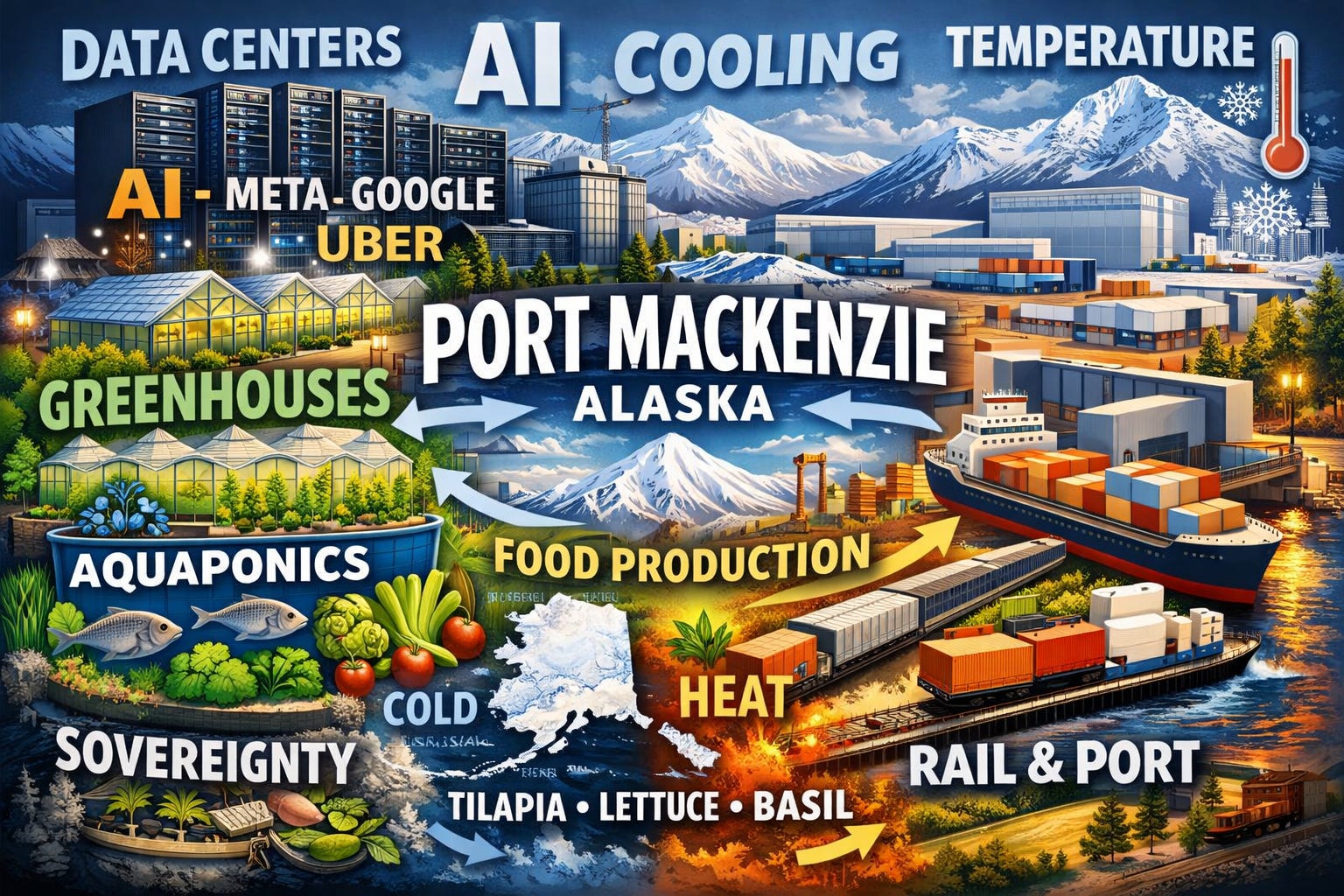
Most Alaskans probably do not spend much time thinking about data centers, and that is understandable. They are not flashy. They do not look like oil rigs, mines, or fish plants. From the outside, they are just large industrial buildings. But inside, Data Centers are the backbone of the modern economy. Every time you check your bank account, stream a movie, make an online purchase, ask an AI system a question, or order up and Uber, that request runs through a data center somewhere. These facilities operate around the clock, and demand for them is growing fast. Artificial intelligence is driving a major expansion across the country, and states are competing aggressively to attract these projects. Those projects bring real capital investment, construction jobs, long-term operations jobs, and local tax revenue.
Alaska should be in that competition, but too often we are not. Too often, we talk like a place that wants economic growth while governing like a place that is afraid of it. We say we want private investment, jobs, lower costs, and a stronger tax base, then spend years tying up serious projects in delay, indecision, and process until the opportunity moves somewhere else. Other states are building industrial capacity. Alaska is still holding meetings and bowing to the environmentalists.
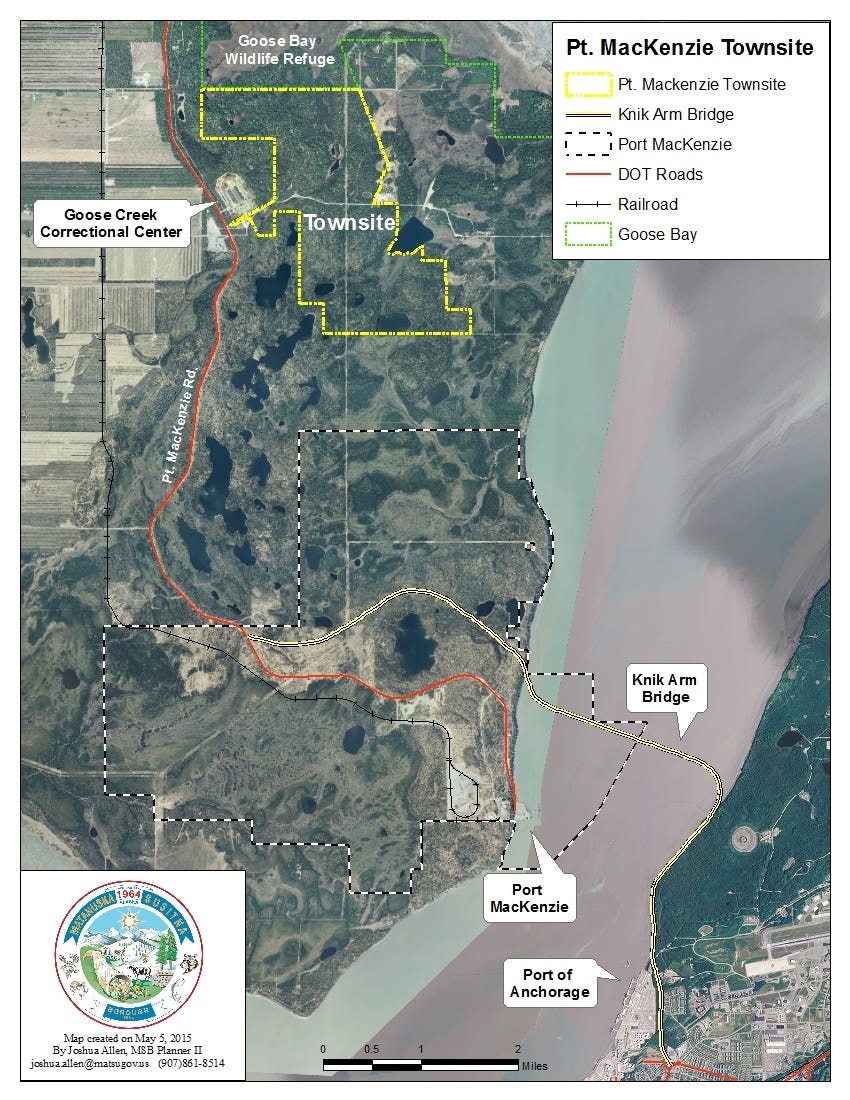
If we are serious about changing that, Point MacKenzie is one of the best places to start. It already has what many places do not, industrial land, port access, room to expand, and the kind of footprint needed to support large-scale infrastructure. In a state that constantly talks about diversification, this is exactly the kind of opportunity we should be evaluating with urgency instead of hesitation.
What makes this especially compelling is that Alaska has an advantage most of the country does not, cold. In this industry, that matters a great deal. Computer servers generate an enormous amount of heat and keeping them cool is one of the biggest operating costs for a large data center. In warmer states, operators often rely on cooling towers, heavy air conditioning loads, and substantial water use just to keep the facility functioning efficiently. In Alaska, that equation changes. For much of the year, the outside air is already cold enough to do a substantial part of the cooling work. That means lower energy demand, less water use, and lower operating costs. What most of the country sees as weather, we can use as infrastructure. That is not a novelty. It is a market advantage.
The technology is also moving quickly. Newer systems use closed-loop liquid cooling, where coolant is circulated directly to the chips and processors generating the heat. Think of it like a radiator system in a vehicle. The heat is absorbed, transferred, cooled, and recirculated in a sealed loop. Some of the most advanced AI systems now use immersion cooling, where entire server racks are placed in non-conductive fluid designed to pull heat away efficiently. These are not futuristic concepts. These are the systems being deployed right now, and Alaska is well positioned to host them if we are willing to stop thinking like a state that assumes someone else will build the future. It must be us, and it must be now. There is no better time.
But the real opportunity is not just in cooling the servers. It is in using the heat they produce. Every one of these facilities generates a constant stream of thermal energy, and in most places much of that heat is simply vented into the atmosphere. That is wasted value. Instead of dumping it into the air, we should be asking what else it can do. One very practical answer is agriculture.
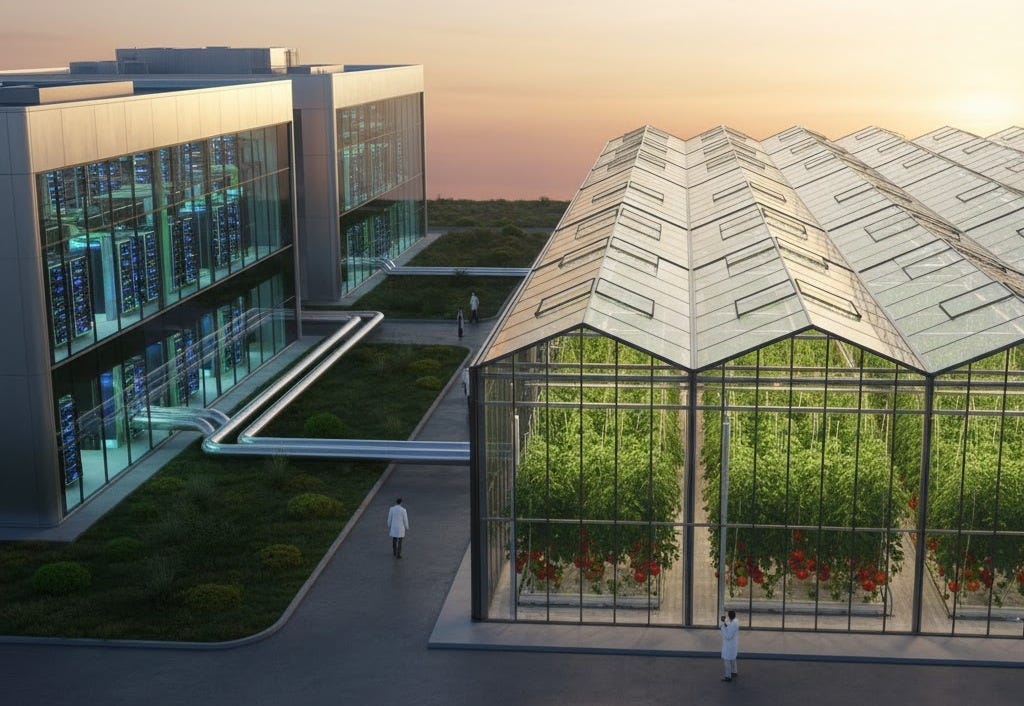
If that waste heat is captured and piped into adjacent greenhouse operations, it can create year-round growing capacity as a direct byproduct of the data center itself. That means the same infrastructure supporting cloud computing and AI processing could also help grow food in Alaska in the middle of winter. This is not some pie-in-the-sky environmental concept designed for a conference panel. It is practical industrial reuse, and it is already happening in other cold-weather regions. In northern Sweden, operators have paired data center infrastructure with commercial greenhouses using recovered server heat to support crop production. Similar concepts have been developed in Quebec, Norway, and Japan, where waste heat has been used to support greenhouse agriculture, aquaculture, and other food systems. In other words, other places are already doing the kind of integrated economic development Alaska keeps claiming it wants.
At Point MacKenzie, that could mean a data center processing AI workloads or cloud storage, with insulated heat-transfer systems feeding adjacent greenhouses producing vegetables year-round, tomatoes in January, leafy greens, herbs, and potentially even fish production through aquaponic systems. That matters more than people think, because Alaska imports most of its food. We all know what that means, high prices, fragile supply chains, and dependence on weather, transportation, and outside markets. We talk a lot in this state about resilience, but resilience is not a slogan. It starts with the basics, energy, freight, and food. This concept touches all three.
The economics just work. The data center benefits from a more efficient cooling strategy. The greenhouse benefits from a stable heat source it would otherwise have to generate with fuel. Together, the system becomes more efficient and more economically viable than either operation standing alone. That means more private investment, more jobs, and more local tax base without asking residents to carry the load. And that’s exactly why Alaskans should be paying attention.
For years, much of our conversation has revolved around what government cannot afford, what taxpayers should be asked to give up, and what new revenue scheme ought to be put on the table next; income tax, sales tax, reduced dividends, or some other way to squeeze the same families who are already paying the price for bad planning and institutional drift. Here’s an idea: build things that create value. Build things that broaden the revenue base. Build things that create real jobs and real infrastructure instead of asking the public to endlessly subsidize stagnation and the race to the bottom.
Of course, there is one obvious and legitimate question, power. A large data center requires serious electricity, and no one should pretend otherwise. Southcentral Alaska already faces real concerns about long-term natural gas supply, and the answer cannot be to dump more cost onto residential ratepayers or destabilize the existing grid. If a project of this scale is going to move forward, it has to be paired with a serious power solution. The right model is not a subsidy or a ratepayer bailout. The right model is a dedicated long-term power arrangement tied to new generation. A project like West Susitna, or another future generation source, becomes much more financially realistic when there is a large anchor customer willing to sign a long-term power purchase agreement. That is how you make new generation pencil out, and when fixed costs are spread across more electricity sales, it can help improve system economics more broadly.
That is how serious places build infrastructure. And we need to get serious. What Alaska has done for too long is treat every major project as if it exists in isolation, energy over here, ports over there, agriculture somewhere else, industrial development in another silo, followed by endless public debate about why nothing ever scales. Meanwhile, other places are building systematic industrial ecosystems while we are still arguing over whether it is acceptable to think bigger than next year’s budget cycle.
That is the bigger point. A data center at Point MacKenzie is not just about servers, and it is not just about AI. It is about whether Alaska is finally willing to think like a state that intends to build a future instead of simply manage decline. For too long, we have lived inside what I have called the Resource Trap. Oil built modern Alaska, and we are all grateful for what it made possible. But the truth is simple, we cannot keep running a 21st-century state on a 20th-century revenue model and pretend the math will somehow fix itself. It will not.
If Alaska is going to remain prosperous, we need projects that create value beyond extraction alone. We need industries that use our geography, our climate, our logistics position, and our available land as real assets. This is one of those opportunities. It creates construction work, long-term operational jobs, local tax base, more local food production, and infrastructure growth, all without asking Alaskans to pay an income tax, a sales tax, or another blank-check subsidy to government.
To be clear, I am not suggesting Alaska should rubber-stamp anything. We should ask hard questions, demand real numbers, require private developers to carry their share of the risk, and protect ratepayers and the public interest. But Alaska also needs to stop pretending that endless caution is the same thing as wisdom. At some point, caution becomes drift, drift becomes decline, and decline becomes policy. We are already seeing what that looks like, higher costs, weaker energy security, a narrower private economy, and more pressure on working families to carry a system that is producing less and costing more.
So yes, everyone ask the hard questions. But if a project makes sense, creates real value, strengthens the state, and helps build the kind of economic base Alaska is going to need for the next millennia, then we ought to have the spine to say yes and move it forward. Otherwise, we are just going to keep doing what Alaska has done for too long, talking about diversification while punishing every serious opportunity to achieve it.
This one is worth more than a hard look, because if we get it right, Alaska could do something most places would never think to do, turn servers into salads.
Alaska needs real economic growth. Not slogans. Not another meeting-heavy vision that ends with ratepayers or borough taxpayers holding the bag. Demand the full numbers: private risk only, no bailouts, transparent coal/CCS economics, actual permanent jobs, and a realistic greenhouse scale that doesn’t require magic. If it pencils without squeezing families, great. Until then, this “servers to salads” pitch smells exactly like what it is, smoke from a coal plant they don’t want you looking at too closely.
Turn servers into salads? Nah. We’re being sold a bill of goods wrapped in pretty greenhouses. Time to call it what it is before another Port MacKenzie-style money pit gets built on our dime.
Great minds think alike. 😉